Technical Blog

Read deep-dive mathematical analyses of forward play, ball aerodynamics, and turf grass maintenance science.

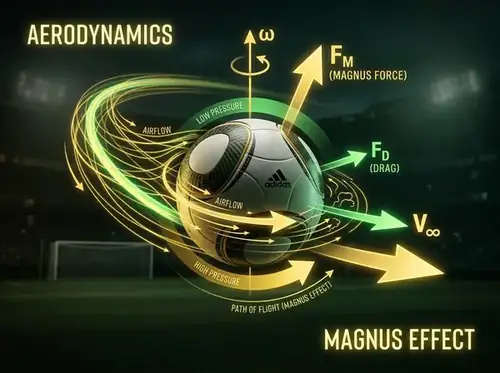
Vector trajectories diagram representing Magnus effect forces on a soccer ball

The Physics of Ball Swerve & Lift

Explore how spin rate modifications generate lateral Magnus force vectors. Learn to predict ball trajectories on curving free-kicks inside closed dome stadiums.

By applying differential equations to the rotation of a standard size-5 soccer ball, we can calculate the air pressure differences on opposite sides of the sphere. Under high humidity conditions, the air molecules stick to the leather panel contours, creating a dramatic pressure differential that curves the trajectory.


Slick cut grass on a professional soccer field

Optimizing Grass Friction for Fast Build-Up

An analysis of how hybrid grass height (22mm to 28mm) and watering schedules affect passing deceleration rates and striker footing coefficients.

Watering the turf exactly 15 minutes before kick-off creates a micro-water film that acts as a lubricant, dropping the sliding friction coefficient to 0.26μ. This allows rapid central passing combinations, allowing the False-Nine to drop, receive, and release the wingers without ball drag interference.

Tactical soccer chalkboard schematic showing 3-vs-2 numbers in final third

Generating 3-vs-2 Overloads in the Box

How to manipulate defending lines using decoy runs, third-man passing sequences, and inverted fullback positioning to release target strikers.

By dragging one centre-back outward with a deep false-nine run, the opposite halfspace opens up for late attacking runs. This tactical dossier details coordinates and passing arrays to consistently create scoring overloads in final third configurations.